
The number most executives have in mind when they think about IT downtime is almost always too low.
They think about the direct cost — the lost transactions during the outage window, the IT vendor call-out fee, maybe some overtime for staff working to recover the system. It feels like a bounded problem. The system went down, the system came back up, the incident is closed.
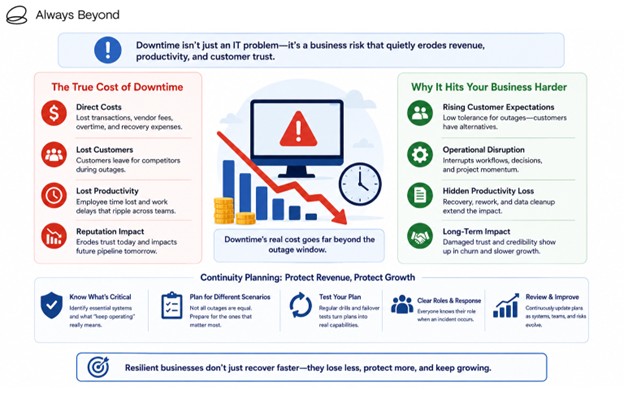
What they’re missing is everything that doesn’t show up on the incident report: the customer who gave up and called a competitor, the contract that slipped because a deadline was missed, the employee hours that disappeared into recovery mode, the accumulated credibility cost that registers only in future pipeline numbers.
Downtime is more expensive than most organizations account for — and the gap between the perceived cost and the actual cost has grown as businesses have become more technology-dependent.
Downtime Is More Expensive Than Most Businesses Think
Industry research consistently puts the average cost of IT downtime at thousands of dollars per hour for small and mid-sized businesses, and dramatically higher for enterprises. But the averages obscure the variance, and they miss the costs that don’t show up in immediate accounting.
Consider a twelve-hour outage affecting a twenty-person team. The obvious cost is 240 person-hours of lost productivity. But the real accounting also includes: what was each of those employees not doing that needed to happen? What client commitments weren’t met? What internal deadlines got pushed? What decisions got delayed because the data or the tools to make them weren’t available?
Then there are the second-order costs. Staff who improvise workarounds during an outage often create data inconsistencies that require cleanup afterward. Processes that get interrupted mid-execution often require more work to complete than if they’d been done without interruption. The recovery period extends well past the moment the system comes back online.
Effective it service continuity management helps organizations maintain operations even during unexpected disruptions — and the ROI case for that investment is substantially stronger when you’re accounting for the full cost of downtime rather than just the surface number.
Customer Expectations Continue to Rise
The tolerance threshold for service interruptions has dropped sharply over the last decade, and it continues to drop.
Customers today have access to alternatives in nearly every category. If they can’t reach you, they can reach a competitor. If your website is unavailable, they’ll find one that isn’t. If your service response is delayed because your systems are down, they’ll note it — and some percentage of them will act on it, either immediately or at renewal time.
This is particularly acute in industries where reliability is a core part of the value proposition. Financial services, logistics, healthcare-adjacent businesses, professional services firms — in these contexts, technology downtime isn’t just an inconvenience. It’s a direct contradiction of what you’re selling.
The customer trust dimension of downtime is almost never captured in incident post-mortems, but it often shows up in churn metrics months later. The connection is real even when it’s hard to trace.
Operational Interruptions Hurt Internal Productivity
The productivity loss from downtime isn’t just about the hours the system was unavailable. It’s about the cascading effects on workflows that depend on those systems.
When a project management platform goes down, teams lose visibility into task status and deadlines. When communication tools fail, coordination happens through improvised channels that leave no record. When CRM systems are unavailable, sales teams either delay customer interactions or handle them without the context and history they need.
None of these interruptions are catastrophic in isolation. But they compound. Information gaps during an outage often create follow-up work. Decisions made without full information sometimes need to be revisited. Work that seemed to get done during an outage sometimes needs to be redone when it turns out it was based on stale data.
The productivity cost of a two-hour outage often extends well past the two hours.
Why Continuity Planning Is Critical
The goal of continuity planning isn’t to prevent every possible failure — that’s not achievable. The goal is to limit the operational and business impact when failures occur.
This requires thinking clearly about which systems are genuinely critical and what “maintaining operations” actually means for each type of disruption. Not all downtime scenarios are equal. A brief interruption to an internal collaboration tool is different from an outage to the core transactional system. Planning that treats all scenarios the same will be over-resourced in some areas and dangerously under-resourced in others.
Effective continuity planning also requires testing. A plan that has never been exercised is a hypothesis, not a capability. Regular drills, failover tests, and incident simulations are the only way to know whether your recovery procedures actually work and how long they actually take.
Organizations that have tested their continuity plans discover two things: some parts work better than expected, and some parts fail in ways that would not have been obvious without testing. Both are valuable discoveries to make in a controlled environment rather than during an actual incident.
Building a More Resilient Organization
Operational resilience isn’t a project with an end date. It’s an ongoing capability that needs to be maintained as the business evolves.
As new systems are added, continuity planning needs to account for them. As team structures change, incident response procedures need to reflect who’s responsible for what. As the threat landscape evolves, recovery time objectives need to be reassessed against current risks.
The businesses that handle disruptions well — and maintain customer and partner confidence through them — are almost never the ones responding to incidents for the first time. They’re the ones who’ve thought through the scenarios, tested the responses, and built organizational muscle memory for operating under pressure.
Technology downtime will happen to every organization. The variable isn’t whether — it’s how much it costs when it does, and how quickly you can return to normal operations. Getting serious about that variable is one of the clearer ROI decisions available to most growing businesses. The cost of prevention is fixed and predictable. The cost of not preventing is not.